Driveway Planning Permission and Dropped Kerbs in Birmingham
Published: 25 September 2026
Two sets of rules decide whether a Birmingham front garden can become a drive: the national planning rule on impermeable paving, and Birmingham City Council's vehicle-crossing scheme for the kerb. Here they are in the order they happen, with the council's 2026 fees and the sequence that stops you paying for a drive you cannot legally reach.
Two Rules, Two Departments, One Order of Work
A new drive answers to two authorities. The planning system (the Planning Portal publishes the rule; the council's planners apply it) decides whether the surface needs permission. The highway authority, also Birmingham City Council but a different department, decides whether you may drop the kerb and drive over the footway. Satisfying one does not satisfy the other.
The order is fixed. The council will not build a crossing until the drive exists and is drained, and the planning rule decides how it must be drained. So: settle the planning position, design the drainage, build the drive, apply, pay, wait. Reverse it and you own a slab you cannot lawfully drive onto.
More than 5m² of impermeable paving in a front garden needs planning permission unless the rain drains to a lawn, border or soakaway inside your boundary. Birmingham City Council needs a drained hardstanding at least 4.75m deep before it will drop the kerb, charges a £125 application fee and a £375 administration fee on top of individually priced construction, and takes at least 16 weeks from payment to build it.
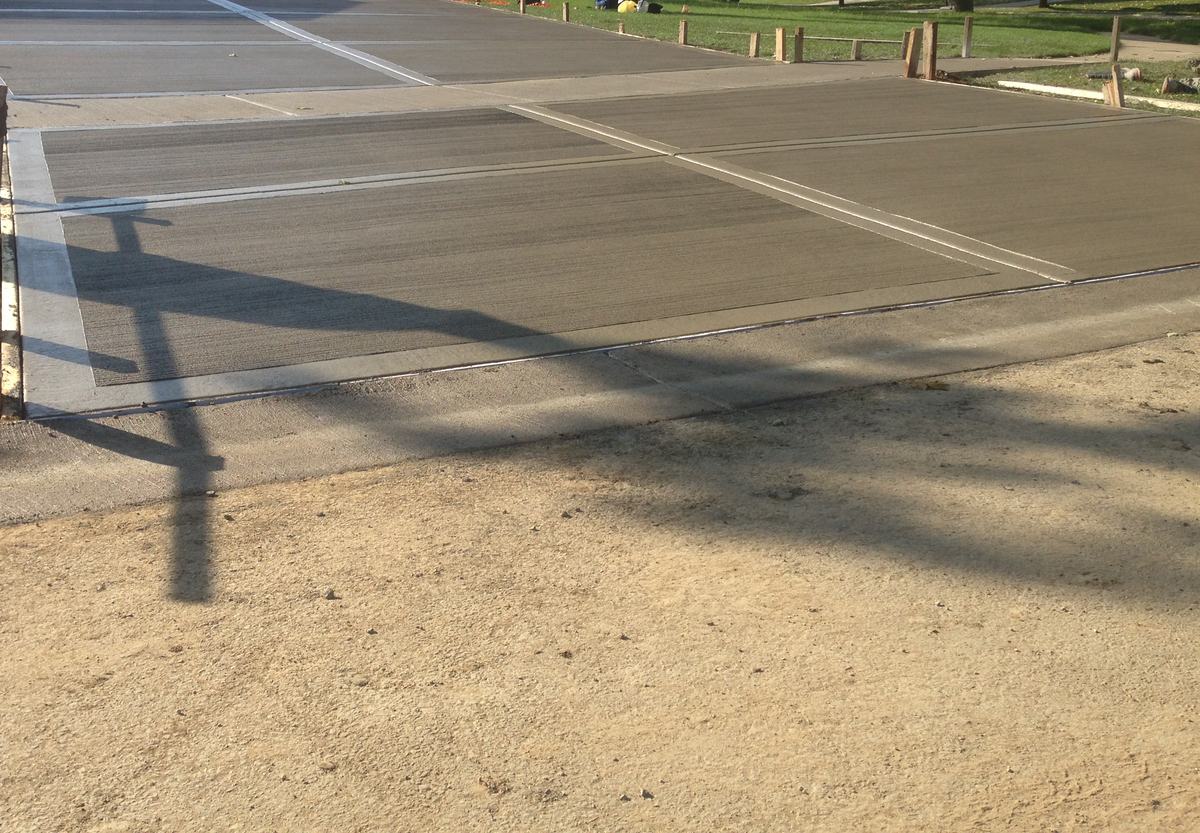
The 5m² Rule for Front Gardens, in Force Since 1 October 2008
On 1 October 2008 the permitted development rules for houses changed. Since then a front-garden drive of any size is permitted development if it uses a permeable surface such as gravel, permeable block paving or porous asphalt, or if its rainwater is directed to a lawn or border to drain naturally. Laying more than five square metres of impermeable surfacing that does not send the water to a permeable area needs planning permission.
Three points trip people up. The rule covers houses, not flats. It covers the front garden, the ground between the house and the highway; a rear patio is not caught. And 5m² is small: a single parking space is around 12m², so every impermeable concrete drive needs either a drainage design or an application. Birmingham City Council repeats the rule on its own dropped-kerb pages, whatever the road classification.
The 2008 guidance quoted a £150 fee and an eight-week decision; fees have risen several times since, and the current figures are in the cost table below.
What Counts as Permeable, and What Counts as Drained
The guidance from the then Department for Communities and Local Government (September 2008, revised May 2009) gives three routes to a lawful drive: a gravel or mainly green surface; permeable block paving, porous asphalt or porous concrete; or an impermeable surface whose water is directed to a border, rain garden or soakaway. Plain and imprinted concrete are the third kind unless you specify a porous mix, so the drainage design is what makes them lawful.
| Surface or arrangement | Permeable? | Planning position | What to watch |
|---|---|---|---|
| Gravel or a mainly planted area | Yes | Permitted development at any size | Loose gravel must be retained at the footway edge before the council will build a crossing |
| Permeable block paving | Yes | Permitted development at any size | Built about 200–250mm deep on open-graded 4/20 stone, not Type 1 |
| Porous asphalt or porous concrete | Yes | Permitted development at any size | Porous concrete exists (see concrete for driveways); may not suit slopes over 1 in 20 |
| Concrete falling to a lawn, border or rain garden | Drained | Permitted development | Keep soakaways and rain gardens away from the house; never direct water towards a neighbour |
| Concrete with a channel at the low edge to a soakaway | Drained | Permitted development | Soakaways can run along the drive's edge; a combined system with an overflow helps on clay |
| Channel connected to the roof-water drain | No | Last resort; may not be permitted development | Allowed on clay or where the drive falls towards the house; confirm with the council |
| Water onto the footway or road | No | Not lawful | The council calls it illegal; it is the surest way to lose a dropped-kerb application |
Slopes decide a lot of Birmingham drives. Fall the drive away from the house towards the road where you can. If it falls towards the house, collect the water in a channel and connect it to the roof-water drains. If it is steeper than about 1 in 20, permeable surfacing may not work: the guidance recommends an impermeable slab drained to a soakaway or rain garden, or as a last resort to the roof-water drain.
For pattern imprinted concrete, which is always impermeable, the SuDS answers are the same three: fall the slab to a lawn or border, run a linear channel along the low edge to a soakaway, or on clay connect that channel to the roof-water drain. Our imprinted concrete driveways and plain concrete driveways pages show where the channel sits in the build-up.
Conservation Areas, Article 4 Directions, Listed Buildings and Classified Roads
Birmingham has 29 conservation areas (the Jewellery Quarter, the Calthorpe Estate in Edgbaston, Moseley and Colmore Row among them), around 1,495 listed buildings and, according to a third-party planning guide to the city, 13 Article 4 direction records. An Article 4 direction removes particular permitted development rights in a defined area, and paving a front garden is exactly the kind of change one can catch; the council's planning pages say whether one covers your street. Within the curtilage of a listed building, permission is always needed.
The council also says planning permission is likely to be required for a crossing at a property on a classified road, typically a main road, so on an A or B road the planning application and the highway application run on separate clocks. Local plans can add a layer of their own: Perry Barr's 3Bs Neighbourhood Plan, put to a referendum in October 2021, discourages the paving of front gardens because of the flooding risk in Perry Beeches, for new applications rather than existing drives.
Trees: protected-tree locations are on the council's GIS mapping, a copy of an order can take up to 10 working days, and work near trees in a conservation area generally needs six weeks' notice. A healthy, well-established tree near the proposed crossing is grounds for rejection whether or not it is protected.
Birmingham City Council's Vehicle-Crossing Process, Step by Step
Check you qualify
You need room for a drive at least 4.75m long (about 15ft 5in) from the footway. The standard crossing is 2.75m wide at the fence, hedge or wall line, widening to 4.5m at the kerb; the maximum length is 8.5m. The drive cannot be steeper than 1 in 10, a healthy, well-established tree nearby or a protected tree means rejection, and tenants need the landlord's or housing provider's written permission.
Build the drained drive first
The council says the driveway must be in place before a crossing can be constructed, on a suitable permeable hardstanding, because it is illegal for water to flow from private property across the pavement. Its examples are porous tarmac or concrete, slab or block paving; a plain or imprinted slab qualifies once it is drained inside the boundary.
Apply and pay the £125
Non-refundable; it covers inspecting the proposed location. Joint applications with a neighbour are allowed, and the application stays open for one year.
Inspection and quote within 28 working days
The price depends on the size of the crossing, materials and labour, any traffic management, and site conditions such as trees and street lighting that may need moving, plus a £375 administration fee for processing the application to completion. Moving non-council assets, utility cables, pipework or street furniture, is paid to the third party separately.
Accept and pay in full within 2 months
No instalments. Blue badge holders may get a discount on a standard 2.75m crossing.
Wait at least 16 weeks
From payment; over 20 weeks where trees, utilities or street furniture are involved, and BT or Virgin Media apparatus alone takes at least 16 weeks. Only the council's authorised contractors and approved suppliers may do the work.
The Sequence: Drainage, Drive, Application, Payment, Wait
| Stage | Who | What has to be true | Typical time |
|---|---|---|---|
| 1. Settle the planning position | You, with the Planning Portal and the council | Permeable or drained inside the boundary; no Article 4, listed curtilage or classified road, or an application is made | Days to check; up to 8 weeks if an application is needed |
| 2. Design the drainage | Your installation partner | Water goes to a lawn, border, soakaway or, on clay, the roof-water drain; never the footway | Part of the survey and written quote |
| 3. Build the drive | The installation partner | At least 4.75m deep, no steeper than 1 in 10, edges retained, drainage in | 2–4 days for plain concrete, 3–4 for a 30m² imprinted drive, then 7–10 days before parking |
| 4. Apply to the council | You, or jointly with a neighbour | £125 paid; landlord's written consent if you rent | Quote within 28 working days of inspection |
| 5. Accept and pay | You | The quote plus the £375 administration fee, in full | Within 2 months |
| 6. Wait for construction | Council-authorised contractors | You cannot cross the footway until it is built | At least 16 weeks; over 20 for non-standard sites |
Add it up and the honest answer to "when can I drive onto it?" is around five to six months from the first phone call, longer where a lamp column or a telecoms cabinet is in the way. Until then the car stays on the road; a contractor who says otherwise is describing a crossing the council can remove.
What a Dropped Kerb Costs in Birmingham in 2026
| Item | 2026 figure | Notes |
|---|---|---|
| Application fee | £125, non-refundable | Birmingham City Council, page updated 1 April 2026; covers the site inspection |
| Administration fee | £375 | Added to the construction quote |
| Construction of the crossing | Priced individually after inspection | National 2026 guides: £800–£2,500, typically £1,300–£1,800 for a standard crossing; size, traffic management and any tree or lighting column move it |
| Moving non-council assets | Paid by you to the utility | Cables, pipework and street furniture belonging to others are excluded from the council's price |
| Planning application, where needed | Check the Planning Portal | 2026 third-party guides quote £272 plus a £99 Portal service charge, or £548 for a householder application |
| The drive itself | £85–£125 per m² plain; £75–£130 per m² imprinted | 2026 guide rates, installed |
Add the two council fees to the national construction range and a Birmingham crossing comes out at roughly £1,300–£3,000 all-in, towards the top where a tree, a lamp column or traffic management is involved. A £113 application fee still circulates online and has been superseded by the £125. None of it is charged by your driveway contractor. For the drive itself, our concrete driveway cost guide and imprinted concrete cost guide work through the totals for 20, 30, 40 and 60m² frontages.
Illegal Kerbs, Doorstep Contractors, and What a Legitimate One Does
The council's page on cowboy contractors says it may remove an illegally dropped kerb, reinstate the footpath and recover the cost from the property owner. It receives dozens of complaints a year about doorstep contractors who resurface a drive, drop the kerb informally and demand cash, and neighbours do report illegal crossings.
- A legitimate contractor puts the drainage on the quote — where the water goes, in writing, before anyone digs.
- Builds to the council's numbers — at least 4.75m deep, no steeper than 1 in 10, edges retained, gravel contained.
- Tells you to apply to the council yourself — and is honest that the crossing takes months.
- Refuses to run water onto the footway — however convenient the levels.
- Gives a written price, a start date and a VAT invoice — not a cash figure on the doorstep.
Drop the kerb themselves (only the council's authorised contractors may) · promise a crossing next to a mature or protected tree · offer to "sort the council later" · take cash up front for the kerb · lay the drive to fall onto the pavement. Any one of these is a reason to call someone else.
Why the Rule Bites Harder in Birmingham
Around 30% of homes in the Birmingham council area are interwar, some 106,000 against a national share of about 15%, and the 1930s semi with a bay window and a big front garden is exactly the house whose lawn is now becoming a drive. Each conversion adds impermeable surface to a street drained for lawns, which is why Perry Beeches residents were telling reporters in 2021 that the fronts used to be lawns, and why the neighbourhood plan there now leans against paving.
The ground does not help. Much of the city sits on Mercia Mudstone, which is weakly permeable, with its top metre or two weathered into shrinkable clay; clayey glacial till dominates the south-west. Soakaways in that ground fill slowly, which is why the guidance's combined arrangement, a soakaway with an overflow to the roof-water drain, is so often the practical Birmingham answer. The flash floods of 27 August 2026 were the latest reminder that runoff is shared, and drainage engineers commenting afterwards argued that the surface, not bigger pipes, is where water has to be dealt with.
One boundary matters most: the council's. The fees and lead times above are Birmingham City Council's, and Sutton Coldfield falls within them. Solihull, Sandwell, Walsall, Dudley and Wolverhampton run their own vehicle-crossing schemes with their own forms and fees; the national planning rule is the same everywhere, the highway process is not. Our installation partners work across the area, including Sutton Coldfield, Solihull, Walsall and West Bromwich, and will tell you which council you are dealing with.
Getting the Drive Priced With the Rules Already Sorted
We are a concrete enquiry service, not a planning consultancy, but the rules above decide the design, so they are the first thing we talk through. Tell us the size, the postcode and whether you will cross the footway; we price the drive the same working day from the published 2026 rates and arrange the work through a local installation partner who surveys, designs the drainage and quotes in writing. Installed work is carried out by a vetted local partner; you'll be told who is attending before the job is booked.
If you already have a contractor, our delivery partners' volumetric trucks batch the air-entrained driveway mix on your street and meter what is poured: see concrete for driveways, run the numbers through the concrete calculator, and order from 0.5m³ through mini mix. Either way, send us the details or call 0121 845 6798 and we will start with the drainage, not the pattern.
Driveway Rules and Dropped Kerb FAQs
Do I need planning permission for a concrete driveway in Birmingham?
Not if the water is dealt with inside your boundary. Since 1 October 2008, paving more than 5m² of a house's front garden with an impermeable surface such as plain or imprinted concrete needs planning permission unless the rainwater drains to a lawn, border or soakaway within the property. Design the drainage and the drive is permitted development; let it run to the footway and it is not. Conservation areas, Article 4 directions, listed buildings and classified roads can add a requirement on top.
What counts as a permeable driveway?
The government's guidance gives three routes: gravel or a mainly planted surface; permeable block paving, porous asphalt or porous concrete on an open-graded sub-base; or an impermeable surface whose water is directed to a border, rain garden or soakaway. A standard concrete slab is the third kind, so it qualifies once it falls to a lawn or has a channel at the low edge running to a soakaway. Birmingham City Council uses the same list when it asks for a permeable hardstanding before a dropped kerb.
How much does a dropped kerb cost in Birmingham in 2026?
Birmingham City Council charges a £125 non-refundable application fee, then a £375 administration fee on top of a construction price it sets individually after inspecting the site. National 2026 guides put construction at £800–£2,500, typically £1,300–£1,800 for a standard crossing, so a Birmingham crossing comes out at roughly £1,300–£3,000 all-in, more where a lamp column, tree or traffic management is involved. Moving other people's cables or pipework is charged separately by the utility.
How long does a dropped kerb take in Birmingham?
The council quotes within 28 working days of inspecting the site, you have 2 months to accept and pay in full, and installation takes at least 16 weeks from payment; sites with trees, utilities or street furniture in the way run to over 20 weeks. Add the week or so to build the drive, which must exist before you apply, and the realistic timeline from first phone call to driving over a legal kerb is around five to six months.
Can my driveway contractor drop the kerb for me?
No. In Birmingham the work can only be carried out by the council's authorised contractors and approved suppliers. A crossing built by anyone else is illegal, and the council says it may remove it, reinstate the footway and recover the cost from the property owner. A legitimate driveway contractor builds and drains the hardstanding, then tells you to apply to the council yourself.
Can I get a dropped kerb if there is a tree outside my house?
Often not. The council rejects applications where there is a healthy, well-established tree nearby or one protected by a preservation order, and where street lighting or other assets must move the quote rises and the wait extends past 20 weeks. Check the council's tree-preservation mapping before you order a drive; if the crossing is refused, the drive still has to be drained inside your boundary.
Want the Drive Priced With the Drainage Designed In?
Size, postcode and whether you will cross the footway — we'll price it the same working day from the 2026 rates and arrange a vetted local partner to survey it and put the drainage on the quote.