Concrete Patios & Paths in Birmingham
One poured slab, brushed, trowelled or imprinted with a stone pattern — no slabs to rock, no joints to weed. We price your patio or path the same working day from published 2026 rates, get the falls and the damp-course level right on paper first, and arrange the work through a vetted local installation partner.
Brushed, Trowelled, Imprinted or Exposed Aggregate
A poured concrete patio is a single 100mm slab of air-entrained concrete on compacted stone, and the finish is chosen while it is still wet. Brushed is the practical default: a soft broom drawn across the direction of travel leaves a fine texture that grips in the rain. Tamped leaves the ridged surface of the tamping beam: more grip, less refinement. Steel-trowelled is smooth and modern-looking but slippery when wet, so it belongs under cover or gets a light brush.
Pattern imprinted concrete is the same slab with a colour surface hardener floated in and texture mats pressed into it — ashlar stone, slate, cobbles or a herringbone brick pattern — then two coats of acrylic sealer. It is the patio version of the imprinted driveways our partners lay, with the same fibre-reinforced, air-entrained mix. Exposed aggregate washes the cement paste off the surface before it hardens to show the stone underneath; it costs the most and hides dirt the best. Colour can be added to any of them; MyJobQuote's 2026 guide prices coloured concrete at £15–£25 per square metre extra.
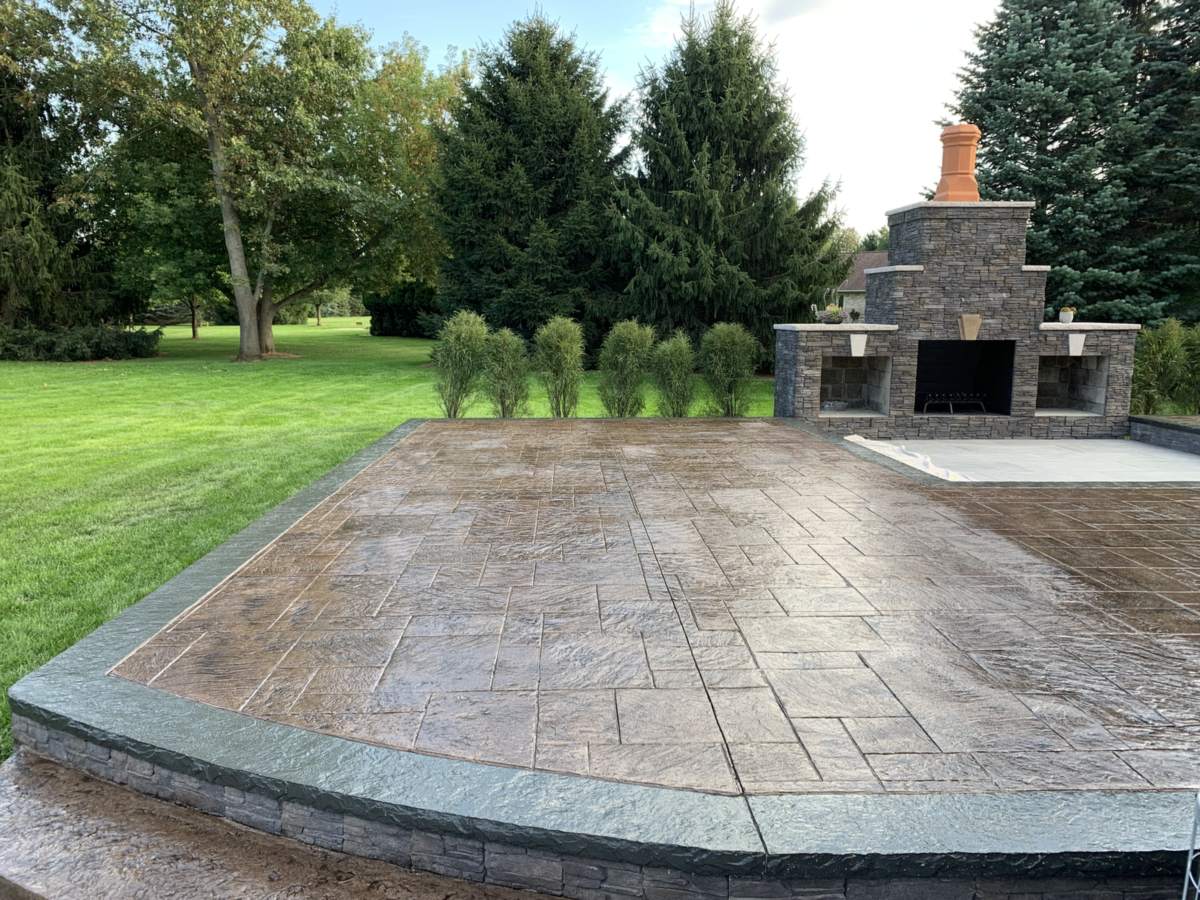
Concrete paths follow the same logic at 75–100mm thick: a brushed finish for grip, a fall to one side, and control joints closer together because the slab is narrower. The mix is the air-entrained C25/30 on our driveway concrete page; a plain C20 slab scales and flakes in frost, and a patio is outside in every Birmingham winter.
How a Concrete Patio Is Built
Levels first
The damp-proof course on the house wall is found and the finished patio level set at least 150mm below it. The fall is planned away from the house at roughly 1 in 60 to 1 in 80 (12–17mm per metre), and the survey decides where the water ends up: lawn, border, soakaway or channel.
Excavate
Old slabs or turf come out and the ground is dug at least 200mm below finished level for a patio (100mm of stone plus 100mm of slab) and 150–200mm for a path. Soft spots are dug out and filled, not bridged.
Sub-base
100mm of MOT Type 1, compacted in layers with a plate compactor; 150–200mm on soft or made ground, with a membrane where the design calls for one.
Formwork and edges
Timber forms are set to the falls, with the diagonals checked. Edge restraints, steps and any drainage channel against the house go in now, because they cannot be added once the slab is down.
Pour and finish
A volumetric truck batches the air-entrained mix at the kerb and meters what is poured; the crew barrows it through the side access if the chute cannot reach. The slab is struck to the falls, tamped, then brushed, trowelled or imprinted, and control joints are cut at about 30 times the slab thickness: every 3m on a 100mm patio, every 2–2.5m on a 75mm path.
Cure, seal, use
Covered and kept damp for three or four days. Walk on it after 24–48 hours; imprinted slabs are washed and sealed once the release agent has done its job. Furniture goes back after about a week, and full design strength arrives at 28 days.
Falls, the DPC and Where the Rain Goes
The rule that decides a patio design is the damp-proof course. External paving must finish at least 150mm below the DPC — two brick courses — or rain splashing off the slab bridges the damp course and shows up as a damp patch on the skirting inside. A level threshold for step-free access can be done, but only with a linear drainage channel against the wall and a design that keeps the wall dry.
The fall goes away from the house, never towards a neighbour's property, and the water has to end somewhere: a lawn or border, a soakaway, or a channel at the low edge. On the clay under most of Birmingham a soakaway drains slowly, and the government's paving guidance allows the channel to be connected to the drain that takes the roof water on clay soils; the survey settles this before the quote.
Planning is simpler than for a drive. The 5m² permeable-surface rule applies to front gardens, so a rear patio at ground level is permitted development for a house, with two exceptions: a platform raised more than 300mm above ground needs planning permission, and listed buildings and the city's 29 conservation areas need checking first. A front path or hardstanding over 5m² must drain to a permeable area inside your boundary; the driveway rules guide covers it.
What a Concrete Patio Costs in Birmingham
Checkatrade's patio guide puts a concrete patio at £65–£120 per square metre plus VAT. Concretecalculate's 2026 patio calculator separates the finishes: basic £60–£85 per square metre, brushed £70–£95, pattern imprinted £100–£145 and exposed aggregate £115–£160, materials being roughly two-thirds of each. Multiplying those rates by 20m² gives the totals below.
| Finish | 2026 guide per m² installed | 20m² patio, guide total |
|---|---|---|
| Plain or tamped | £60–£85 | £1,200–£1,700 |
| Brushed | £70–£95 | £1,400–£1,900 |
| Pattern imprinted | £100–£145 | £2,000–£2,900 |
| Exposed aggregate | £115–£160 | £2,300–£3,200 |
Guide ranges from the 2026 concretecalculate and Checkatrade cost guides; MyJobQuote's September 2026 patio guide brackets a 20m² patio at £900–£2,000 across all materials. Your partner's written quote is the price. What moves it:
- Ground preparation — breaking out old slabs, digging and carting away is £40–£70 per square metre where it is quoted separately; a skip is around £250.
- Access — a back garden reached through a side gate is barrowed; a patio the truck can chute onto is cheaper.
- Drainage — a channel and soakaway, or a connection to the roof-water drain, is the difference between a patio and a damp wall.
- Steps, edges and levels — retaining edges and steps on a sloping garden add formwork and labour.
- Pattern and colour — one pattern in one colour is the baseline; borders and contrasting colours take longer.
The concrete is a small share: a 20m² patio at 100mm is 2m³, about £230 plus VAT at the air-entrained rate from £115 per m³ on our driveway concrete page; labour, stone, formwork and the skip are the rest. Check your own area with the concrete calculator, and see the ready mix concrete prices guide for every grade.
Poured Concrete vs Paving Slabs and Porcelain
| Surface | 2026 guide per m² installed | Joints and weeds | Where it wins |
|---|---|---|---|
| Poured concrete, brushed | £70–£95 | Control joints only | Large or awkward shapes, level access, low upkeep, budget |
| Pattern imprinted concrete | £100–£145 | None | Stone or slate look without loose slabs; reseal every 2–5 years |
| Concrete paving slabs | £90–£130 | Mortar or sand joints; weeds and rocking over time | Individual slabs can be lifted to reach services; DIY-friendly |
| Porcelain paving | Above slab prices; quoted per job | Grouted joints, no weeds | Premium look and stain resistance; needs a full mortar bed and a primer |
Slab prices from BookaBuilderUK's May 2026 patio guide. Poured concrete wins on shape, level access, maintenance and price for larger areas; slabs and porcelain win when you want a particular product, expect to lift the surface for drains or cables later, or want to lay it yourself. The longer comparison with resin, block paving and tarmac is in imprinted concrete vs block paving vs resin.
Maintenance and Resealing
A brushed or tamped patio wants almost nothing: a hose or a pressure wash in spring, and no de-icing salt in winter, because the air-entrained mix is specified for paving without salts. Small cracks are repaired for £100–£300 and a worn surface resurfaced at £40–£70 per square metre; see repair and resealing.
Imprinted concrete has a wearing layer, the sealer. Plan to reseal every 2–5 years (Pavingexpert says 2–4, the 2026 cost guides 3–5) at £4–£8 per square metre professionally, or £55–£110 for 20 litres of sealer if you do it yourself. Ask for an anti-slip additive in the sealer around a pool or on a north-facing patio, and do not paint it: paint sits on the sealer and peels. The colours, patterns and sealing guide has the detail.
Our installation partners work across the city and the West Midlands, including Solihull, Sutton Coldfield, Lichfield, Redditch and Stourbridge; the long back gardens of the city's interwar semis, with the side gate as the only way in, are the jobs they price most often.
Supply and Lay, or Supply Only
Supply and lay: tell us the size, the finish and the postcode, and we price the whole job from the rates above, then arrange it through a vetted local partner who surveys the levels, quotes in writing and does the work. Installed work is carried out by a vetted local partner; you'll be told who is attending before the job is booked.
Supply only: if you or your landscaper are laying it, our delivery partners batch the air-entrained mix on your street from 0.5m³ with no part-load penalty and meter what is poured — see concrete for driveways and paving, check the volume with the concrete calculator, and order through mini mix.
Either way the concrete is the same and the levels are designed rather than hoped for. Related installed work: imprinted concrete driveways, concrete driveways, garage, shed and garden room bases, and the full list of installed concrete services.
Concrete Patio & Path FAQs
How much does a concrete patio cost in Birmingham?
As a 2026 guide, £60–£95 per square metre installed for a plain or brushed finish, £100–£145 for pattern imprinted and £115–£160 for exposed aggregate, plus VAT in most guides. A typical 20m² patio therefore runs about £1,200–£1,900 brushed or £2,000–£2,900 imprinted, before ground preparation of £40–£70 per square metre where an old patio has to come out. Your partner's written quote is the price.
How thick should a concrete patio be?
100mm of air-entrained C25/30 concrete on 100mm of compacted MOT Type 1 for a patio, and 75–100mm for a path. Control joints are cut at about 30 times the slab thickness, so every 3m on a patio and every 2–2.5m on a narrow path. A plain C20 mix is cheaper per cubic metre and flakes in frost; the air-entrained paving mix is the one to specify.
Can a concrete patio be laid level with the house floor?
Not as a default. The finished surface must be at least 150mm below the damp-proof course, or splashing rain bridges the DPC and the wall gets damp inside. A level threshold for step-free access is possible with a linear drainage channel against the wall and a fall away from it, but it has to be designed and drained, not just poured higher.
Do I need planning permission for a concrete patio?
Usually not for a rear patio at ground level on a house: the 5m² permeable-surface rule applies to front gardens. You do need permission if the patio is raised more than 300mm above ground, and you should check first for a listed building or a conservation area. A front path or hardstanding over 5m² must drain to a lawn, border or soakaway inside your boundary.
Is imprinted concrete slippery, and does it need resealing?
Sealed imprinted concrete can be slippery when wet, so ask for an anti-slip additive in the sealer, especially by a pool or on a shaded patio. The sealer is the wearing layer and wants renewing every 2–5 years at £4–£8 per square metre professionally; a brushed or tamped patio needs no sealing at all.
How long does a patio take, and when can I use it?
Three to four days for a typical 20m² patio: dig and sub-base first, formwork and the pour on one day, then joint cutting and, for imprinted work, washing and sealing once the surface has hardened. Walk on it after 24–48 hours, put the furniture back after about a week, and expect full strength at 28 days.
Want a Price on Your Patio Today?
Size, finish and postcode — we'll price it the same working day from the 2026 rates above and arrange a vetted local partner to survey the levels.