Imprinted Concrete Colours, Patterns and Sealing
Published: 25 September 2026
The colour on an imprinted drive is not paint and the pattern is not a veneer: both are worked into the top of the slab on pour day and protected by a sealer that wears. How the colour goes in, which patterns suit which Birmingham houses, and why the sealer decides how the drive looks in year five.
Colour Hardener vs Integral Colour
Nearly every imprinted drive is coloured with a colour surface hardener: a dry mix of pigment, cement and fine sand dusted over the wet slab at about 1.5kg per m² in two or three passes and floated in, so the top few millimetres become a dense coloured skin harder than the concrete beneath. That skin is what the texture mats press into.
Integral colour is pigment batched into the concrete itself, so the colour runs all the way through: a softer, more uniform tone and no grey in a chip, but nothing extra for surface hardness. MyJobQuote prices coloured concrete at an extra £15–£25 per m²; WhatCost puts coloured concrete at around £80 per m².
| Colour hardener | Integral colour | |
|---|---|---|
| How it goes in | Dusted onto the wet slab at about 1.5kg per m² and floated in | Pigment batched into the concrete |
| Surface | Denser and harder than the slab below; the pattern takes crisply | Same as the rest of the slab |
| If it chips | Grey concrete shows in a deep chip | The colour continues |
| Cost | Inside the imprinted per-m² rate | An extra £15–£25 per m² on plain concrete (MyJobQuote) |
| Used for | Almost all pattern imprinted work | Coloured brushed or exposed-aggregate drives |
Release Agent and the Antique Effect
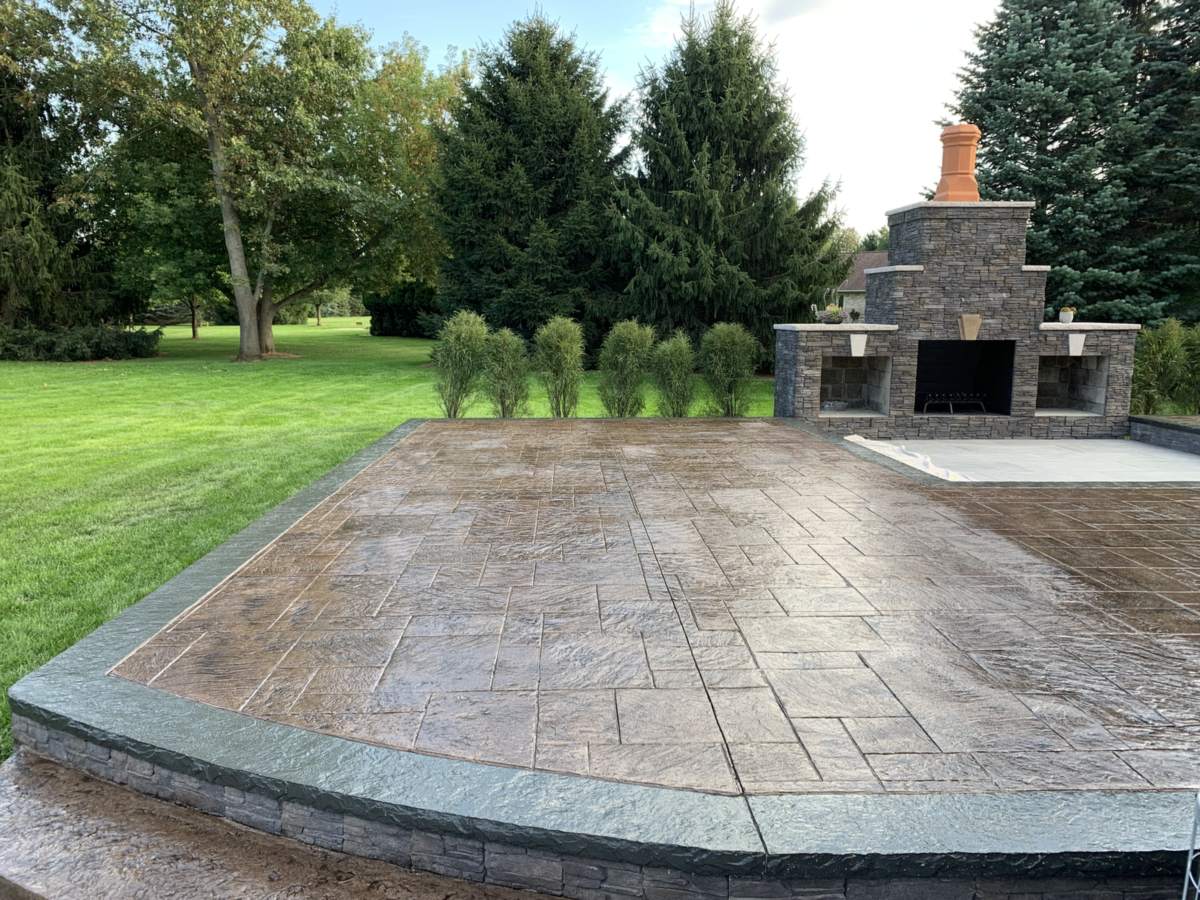
Before the mats go on, the crew dusts the slab with a release agent, about 200g per m², so the mats lift cleanly. It is almost always pigmented darker than the hardener: charcoal over buff, black over grey. After 24–48 hours the loose release is washed off, and what stays in the grain and joints is the second colour: the antique effect that makes the drive read as stone rather than coloured concrete.
It is also where most cosmetic complaints start. Pavingexpert lists "poor floating of the colour hardener and/or the release agent" among the common faults, and a patchy wash-off leaves darker blotches the sealer then locks in. Keep it to two tones, name both on the quote, and look at the wash-off before sealing.
Common Patterns and the Birmingham Houses They Suit
The mats set the look, and the house should set the mats: around 30% of Birmingham's homes are interwar semis and 23% are pre-1919 terraces, and each era has a pattern that sits naturally in front of it.
| Pattern | The look | Suits | Notes |
|---|---|---|---|
| Ashlar slate | Large rectangular flags with a riven slate texture | 1930s semis, post-war and modern houses; the default | Best on wide frontages, where the joints read as real flags |
| Cobble | Small rounded setts in rows or fans | Victorian and Edwardian terraces, courtyards | The most detailed mat: more pressing and sealing time, so the top of the price band |
| Random stone or slate | Irregular flagstones | Cottages and the semi-rural edges of Sutton Coldfield, Solihull and Lichfield | Hides the control joints better than a grid |
| Herringbone brick | Bricks at 45° or 90° | Red-brick terraces and semis | The look of block paving without the sand joints |
| Wood plank | Boards with grain | Patios, garden rooms, contemporary builds | Seen far more on patios than drives; the grain holds dirt under tyres |
A contrasting border, usually a running-bond brick edge around an ashlar field, is the commonest upgrade and adds most to the price: a second mat and a second colour on the same afternoon. Control joints are cut at roughly 3m centres whatever the pattern; on a grid a good crew lines the cut up with a pattern joint. The imprinted concrete cost guide shows what patterns and borders do to the rate.
Sealer Types and the Re-seal Cycle
An imprinted drive gets one or preferably two coats of acrylic sealer once the release has been washed off and the surface is dry. Solvent-based acrylics give the deeper wet-look gloss most people picture and re-coat happily over old solvent sealer. Water-based acrylics are low-odour and come in satin and matt, but do not always take over an old solvent coat, so find out which was used first and stay with it. On a slope, ask for an anti-slip additive in the top coat.
The sealer is the part that wears. MyJobQuote and Checkatrade's Birmingham page both say every three to five years; Pavingexpert says two to four, with acrylic sealers lasting two to five years. The signs: the gloss goes flat, the colour looks dusty and rain soaks in rather than beading.
| Drive | Professional reseal at £4–£8 per m² (MyJobQuote) | Over 10 years, two or three reseals |
|---|---|---|
| 30m² | £120–£240 | £240–£720 |
| 40m² | £160–£320 | £320–£960 |
| 60m² | £240–£480 | £480–£1,440 |
A 20-litre tub of DIY sealer is £55–£110 (MyJobQuote). Whoever does it: clean, let it dry right through, then two thin coats; sealer over a damp slab turns milky. Our repair and resealing page covers stand-alone resealing.
Why Painting Imprinted Concrete Fails
"Imprinted concrete paint" is what people search for when a drive has gone dull, and it is the wrong answer. Paint will not bond to a sealed surface. Masonry paint is a film, and tyres, sunlight and frost lift films. It traps moisture, so it blisters in summer and flakes in winter. And the only way back is stripping or grinding, which takes the colour hardener with it.
The right fixes are cheaper. A faded drive almost always needs a clean and a reseal, because the pigment is still there under the worn sealer. Where the colour needs evening out, a tinted sealer does it without hiding the texture. Where the surface is worn through, MyJobQuote prices resurfacing at £40–£70 per m².
Cleaning, De-icing Salt and the Air-Entrained Mix
Day to day, a hose and a soft brush. A pressure washer is fine on a fan setting held off the surface; a narrow jet up close strips sealer and lifts the release colour in stripes. Treat algae and lichen, which Pavingexpert lists among the common problems, before they get into the texture.
Winter is where the mix matters. The driveway concrete on this site is an air-entrained C25/30, the mix builders call PAV1, with a minimum 4.5% of entrained air: microscopic bubbles that give freezing water room to expand, which is what stops the surface scaling in frost. The same page notes that PAV1 is specified for domestic paving without de-icing salts; salted paving steps up to a PAV2-equivalent C32/40. So use sharp sand or grit for winter grip rather than rock salt, and if a drive flakes in its first winters suspect the mix, not the sealer: plain C20 concrete scales and spalls in frost, as our driveway concrete page explains.
Colour Fading and Matching on Repairs
What fades on an imprinted drive is rarely the colour. Hardener pigments are mineral oxides and stay put; what goes is the gloss of the sealer and the darker release tone on the high spots. Reseal it and most of the depth comes back. Uneven colour from the first month is different: hardener or release floated unevenly on pour day, which no sealer fixes.
Repairs are the honest weakness. A new patch of hardener and release under new sealer never quite matches a surface that has aged, and on a plain ashlar field it shows. Small crack repairs run £100–£300 (MyJobQuote); the way to hide them is to reseal the whole drive afterwards, ideally with a lightly tinted sealer.
Birmingham and the West Midlands
Birmingham's housing decides the pattern more than fashion does: ashlar slate for the 1930s semi, cobble and herringbone brick for the pre-1919 terraces, and a plain field with a simple border for the narrow frontages of the interwar council estates, more than 51,000 homes. Colour and pattern are not a planning matter, but drainage is: Birmingham City Council requires planning permission to resurface more than 5m² of a private drive with an impermeable surface unless the rainwater is kept off the road, and our driveway rules guide sets out the options.
Drives under mature trees in Sutton Coldfield and Solihull stay damp and shaded, so plan on the shorter end of the sealing range. Our installation partners quote across the region, including Sutton Coldfield, Solihull, Lichfield and Tamworth.
Colours, Patterns and Sealing FAQs
What colours can imprinted concrete be?
Anything in the colour hardener range: buffs and sandstones, greys and slates, terracottas and brick reds, charcoals, with a darker release agent adding a second tone. Names differ between manufacturers, so choose from a cured, sealed sample, and have the pattern, base colour and release colour written on the quote.
Can you paint imprinted concrete?
You can, and it fails: paint will not bond to a sealed surface, tyres and sunlight lift it as a film, and it cannot be undone without stripping. A faded drive needs cleaning and resealing; for a colour change use a tinted sealer, and for a surface worn through, resurfacing at £40–£70 per m².
How often should imprinted concrete be resealed, and what does it cost?
Every three to five years, at £4–£8 per m² for a professional reseal (MyJobQuote), so £120–£240 for a 30m² drive; Pavingexpert says every two to four years. A 20-litre tub of DIY sealer is £55–£110. Two thin coats, on a clean, dry slab.
Why has my imprinted drive faded or gone patchy?
The sealer has worn, not the colour: the mineral pigment does not fade, but the gloss goes and the darker release tone wears off the high spots. Cleaning and resealing brings most of it back. Patchiness from day one usually means the hardener or release was floated unevenly, a workmanship fault Pavingexpert lists as common.
Can a repair on imprinted concrete be colour-matched?
Not exactly. The original hardener, release, wear and sealer age combine into a colour no new patch can copy. Small crack repairs are £100–£300 (MyJobQuote); the way to hide them is to reseal the whole drive afterwards, ideally with a lightly tinted sealer.
Getting an Imprinted Drive Priced
Tell us the size, the postcode and the pattern you have in mind, and we price it the same working day from published 2026 rates, then arrange a vetted local installation partner to survey it, show you cured samples and quote in writing. Installed work is carried out by a vetted local partner; you'll be told who is attending before the job is booked.
Service pages: imprinted concrete driveways and plain concrete driveways. Supply only: concrete for driveways and the concrete calculator. Against blocks and resin: imprinted concrete vs block paving vs resin.
Chosen a Pattern? Get It Priced.
Size, postcode, pattern and colour — we'll price it the same working day from the 2026 rates and arrange a vetted local partner to survey it.